
Reading the Audit Log
See a filtered, time-stamped history of every action in your clinic — who did what, and when.
The Clinic's Black Box
Every clinic eventually meets a question that memory can't answer: who changed this patient's phone number, who read that record, did anyone export data last month? The Audit Log (Settings > Audit Log, owner and Full Access only) is the flight recorder — every data access and modification, captured automatically, editable by no one. Most days you'll never open it; the day you need it, nothing else will do.
What Gets Recorded
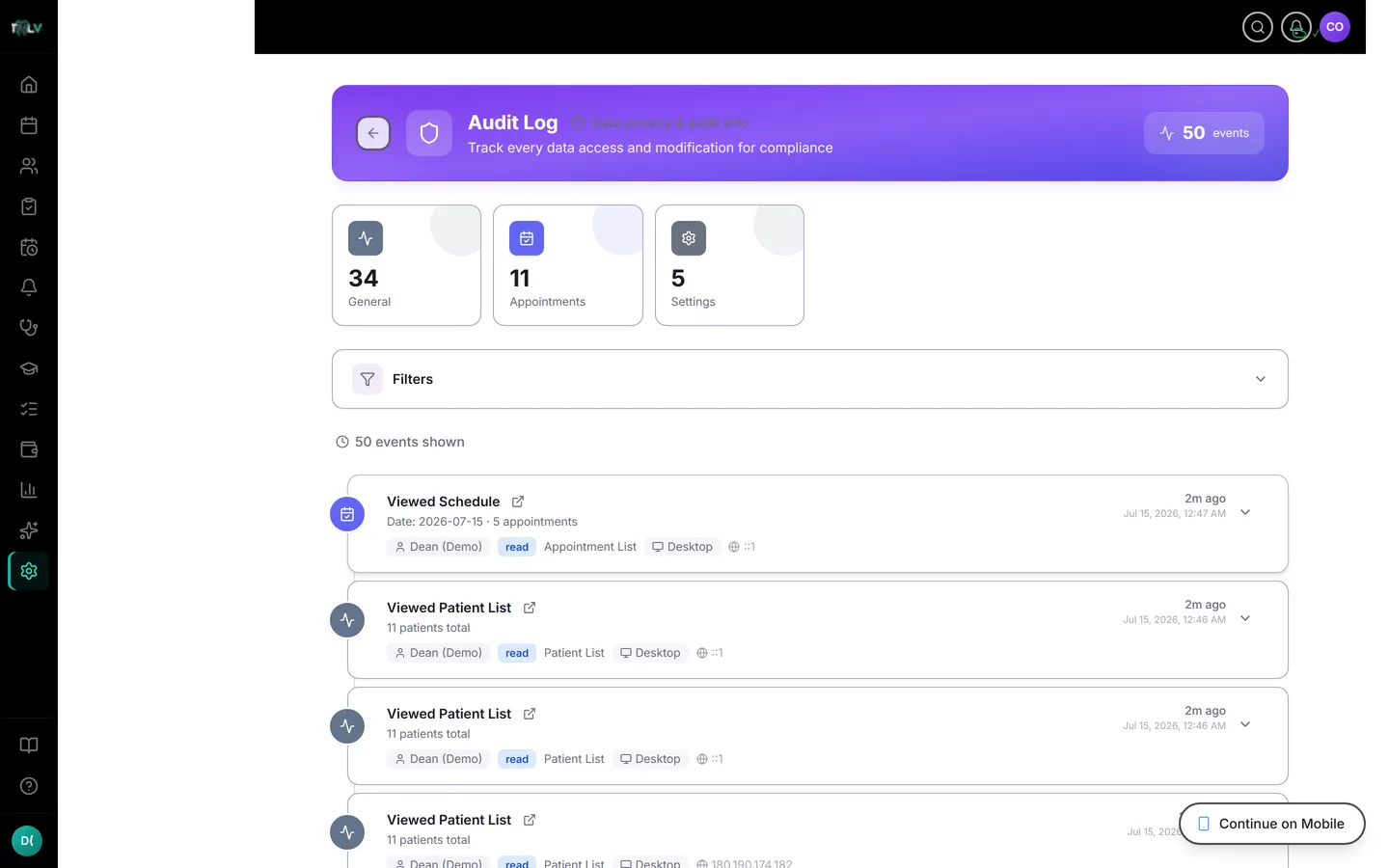
Creates, reads, updates, deletes, logins, logouts, and exports — across Patients, Appointments, Billing, Team, SMS, Settings, and Security. Automated jobs appear as "System" entries, so machine actions are as visible as human ones. Summary cards up top turn the stream into a day-glance: check-ins, SMS, registrations, appointments, team and billing events.
Reading an Entry
Each row shows who did what and when (Manila time), from which device and IP. Expanding is where it earns its keep: updates carry a field-level Changes diff — old value → new value — creates and deletes list their details, and the raw payload sits underneath for the technically curious. "Her mobile number is wrong" becomes: changed on July 3rd, 2:14 PM, by that specific login, from the front-desk PC, from this value to that one. Conversations end quickly with that kind of answer.
Finding the Needle
Open Filters and stack them: a patient search (3+ characters), a From/To date range, the Action type, the Category, a specific Staff Member. The workhorse combination is patient + date range — and a patient profile's Audit Log button jumps here pre-filtered to them. Load more events pages back through time; events are retained for review for 90 days.
Why It Matters Beyond Curiosity
RA 10173's accountability principle expects you to know who accessed personal data — the log is that, printable. It's also the fair referee for internal questions: before any "who deleted the 3 PM appointment?" hardens into an accusation, the log answers it neutrally. And because every staff action is attributable, its mere existence raises care levels — people are tidier when the record keeps score.
One prerequisite makes all of it work: individual logins. A shared "frontdesk" account reduces every entry to "someone did it," which is exactly the answer the log exists to end.
Was this article helpful?
Need more help? Contact our support team