
At-Risk Students & Cohort Standing
Catch struggling students early with a worst-first cohort ranking and automatic risk flags.
Finding the Struggling Student in October, Not March
In a cohort of forty, the student quietly falling behind is invisible until the numbers make them visible — and by the time a graduation audit notices, the recovery options are ugly. At-Risk Students (also called Cohort Standing) exists to move that discovery to October: the whole cohort ranked by completion, worst first, with risk flags computed on every visit to the page.
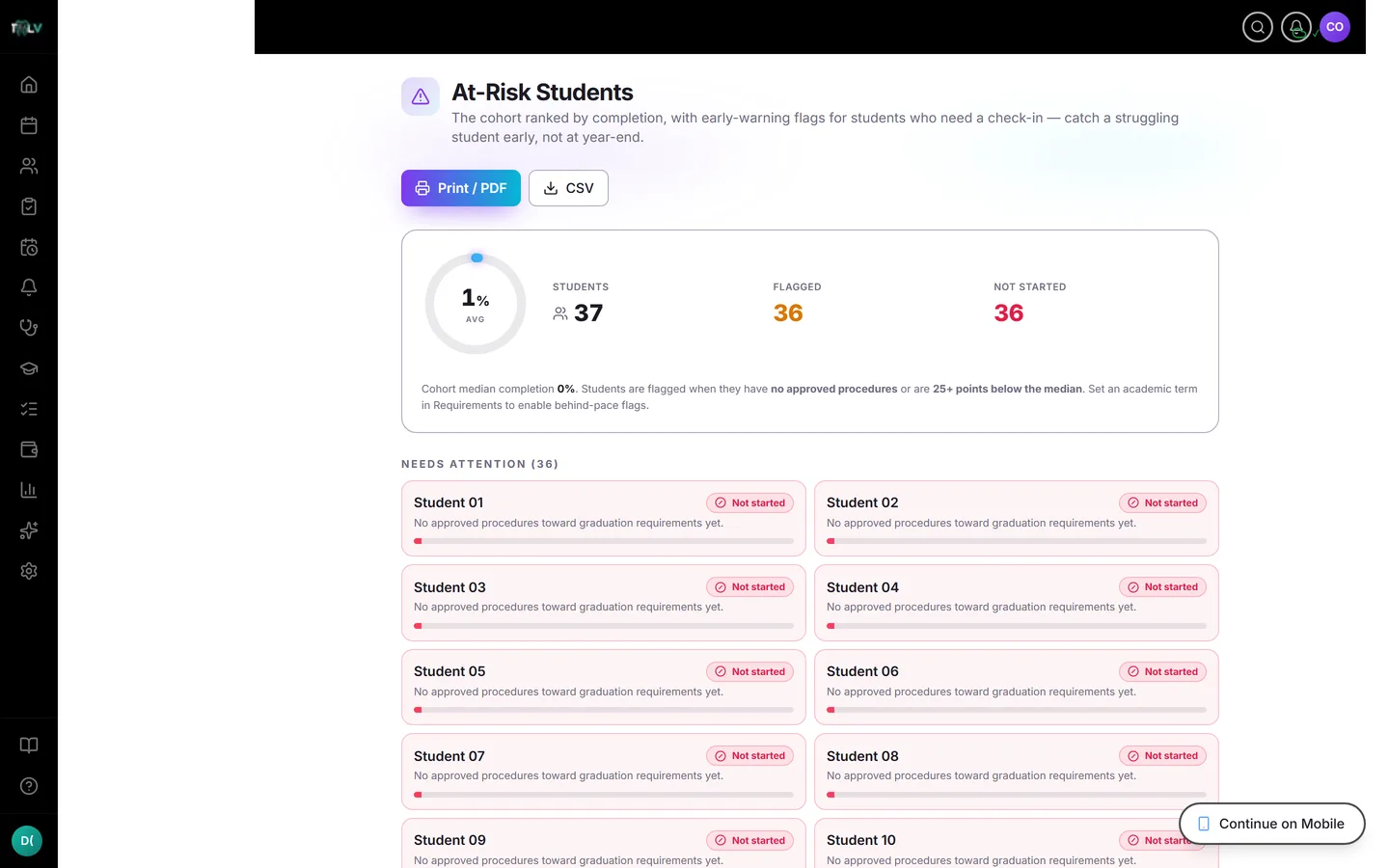
Reading the Page
Snapshot tiles up top: the cohort-average completion ring, student count, flagged count, not-started count, and the cohort median. Below, the ranked table — each row a student with their completion bar, requirements met, untouched categories, and a status pill. The sort order is the triage order: start at the top, work down.
The Three Flags, Precisely
- Not started (critical) — no professor-approved procedures toward any requirement. Early-term this is enrollment noise; past week four it means the student isn't treating, isn't logging, or isn't getting sign-offs — three different problems, all urgent.
- Behind pace (warning) — 20+ points below where the current academic term says they should be by now. This is the earliest useful signal, and it requires a current term to be set in Requirements; no term, no pace math.
- Behind cohort (warning) — 25+ points below the cohort median. The relative flag: even mid-term, being far behind peers predicts trouble. Pace takes precedence when both apply.
Completion numbers are always whole-program — selecting a term changes only the pace reference, never the totals.
From Flag to Intervention
The page finds; faculty fix. The playbook that works: open the flagged student's row and see which categories are untouched — a student behind everywhere has a workload or attendance problem; a student behind only in surgery has a case-access problem. Cross-check Faculty Supervision before assuming the student is the bottleneck: a pile of pending sign-offs can make a hard-working student look idle, and the fix there is a professor's queue, not a student conversation. Then check Case Mix — if the whole cohort is starved of a procedure type, no individual intervention will fix supply.
Cadence
Weekly glance at the tiles; monthly working session on the full ranking; before each term break, print or CSV-export the standing for the faculty meeting — the trend between snapshots tells you whether interventions are landing.
Was this article helpful?
Need more help? Contact our support team