
Case Mix: What Your Clinic Treats
See your procedure-type distribution, requirement supply vs. demand, and anatomical coverage for curriculum planning.
What Does This Clinic Actually Treat?
A training program's promise is exposure: enough restorations, extractions, and root canals for every student to learn on. Whether the clinic's real patient flow keeps that promise is an empirical question, and Case Mix answers it — the procedure-type distribution of everything logged, requirement supply versus cohort demand, and where in the mouth the work happens.
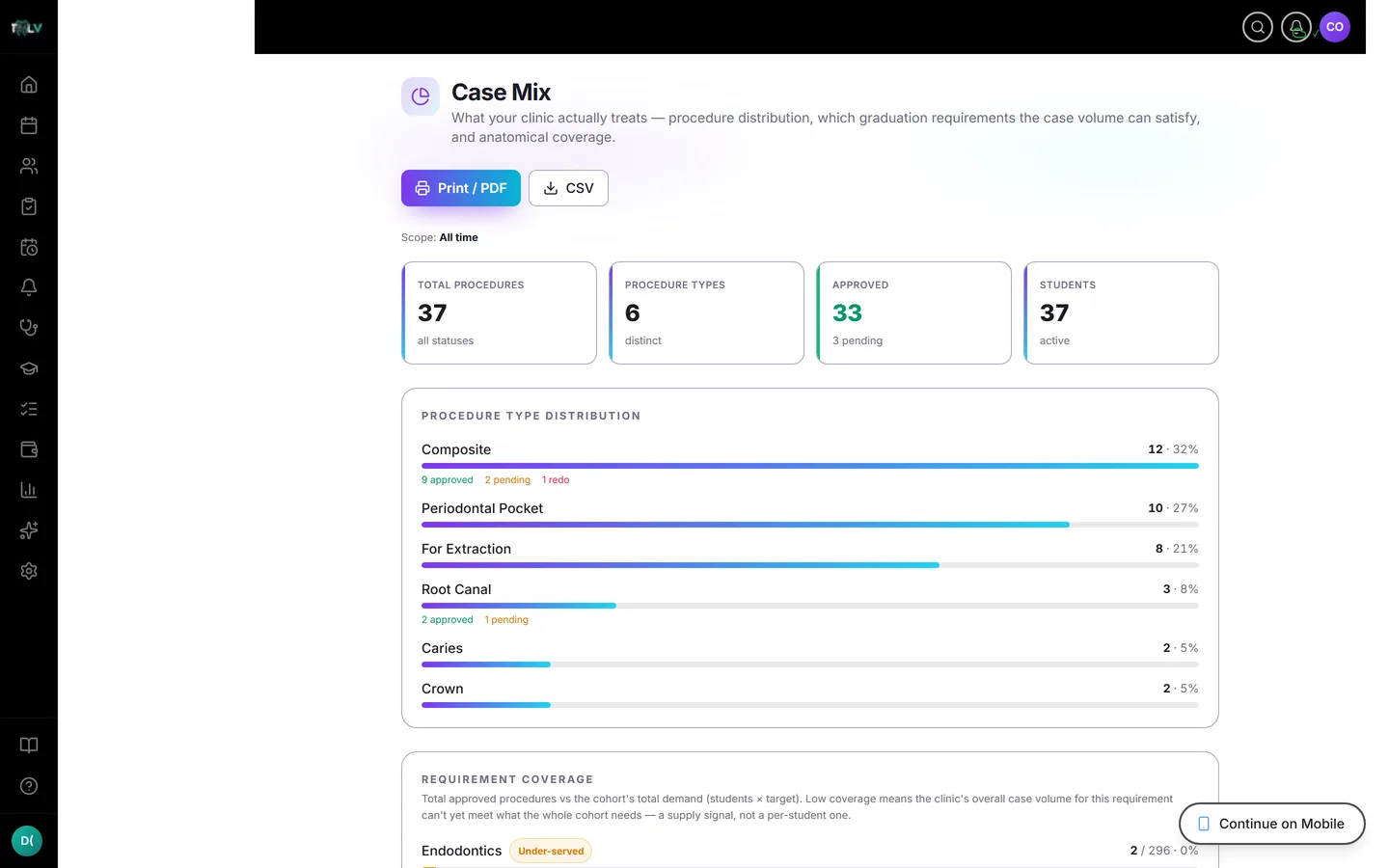
The Distribution
Every logged procedure, broken down by type, split into approved / pending / needs-redo, with each type's share of the total. This is the clinic's clinical diet at a glance — and usually the first surprise: programs consistently overestimate their surgical volume and underestimate how much of the book is prophylaxis.
Coverage: Supply vs Demand
The strategic section. For each requirement category, coverage compares approved supply against cohort demand (students × target). A category below 50% of demand is flagged under-served — the arithmetic version of "we will not graduate this cohort at current case flow." Two honesty rules built in: coverage only counts categories with a real quota (tracked-only categories are excluded), and it's cumulative-only — under a term filter the section hides itself rather than show misleading windowed numbers.
Under-served flags are recruitment tasks, not report trivia: an endodontics shortfall in October means outreach — referral arrangements, community screening days, fee adjustments on that procedure — while there's still time for the pipeline to fill.
Anatomical Coverage
The four-region map (upper/lower × anterior/posterior) shows where students are working. A cohort rich in anterior restorations but starved of posterior endo is a real curricular gap that procedure counts alone won't reveal — molar work is different work.
Scoping and Sharing
The term selector defaults to All time; term scope answers "what did this semester treat?" while coverage stays cumulative. Print / PDF for the curriculum committee, CSV for analysis (the CSV honestly omits coverage when term-scoped). If the page says "Case Mix isn't available yet," the supporting database update hasn't been applied to your environment — contact support.
The Termly Ritual
Once a term, put three numbers in front of faculty: the under-served categories (recruitment targets), the distribution shifts since last term (is the case mix drifting?), and the anatomical gaps. Twenty minutes of Case Mix per term is the difference between managing case supply and discovering it.
Was this article helpful?
Need more help? Contact our support team