
Faculty Supervision & Sign-Off Load
See each professor's review load, redo rate, and turnaround — plus the live queue of work waiting for sign-off.
The Bottleneck Nobody Logs
In a teaching clinic, student work only counts once a professor signs it off — which makes professors' review queues part of the production line. A diligent student under a swamped professor looks identical, on paper, to a lazy one: work done, nothing approved. Faculty Supervision makes that layer visible — per-professor load, speed, and strictness, plus the live queue of work waiting for review.
The Per-Professor Table
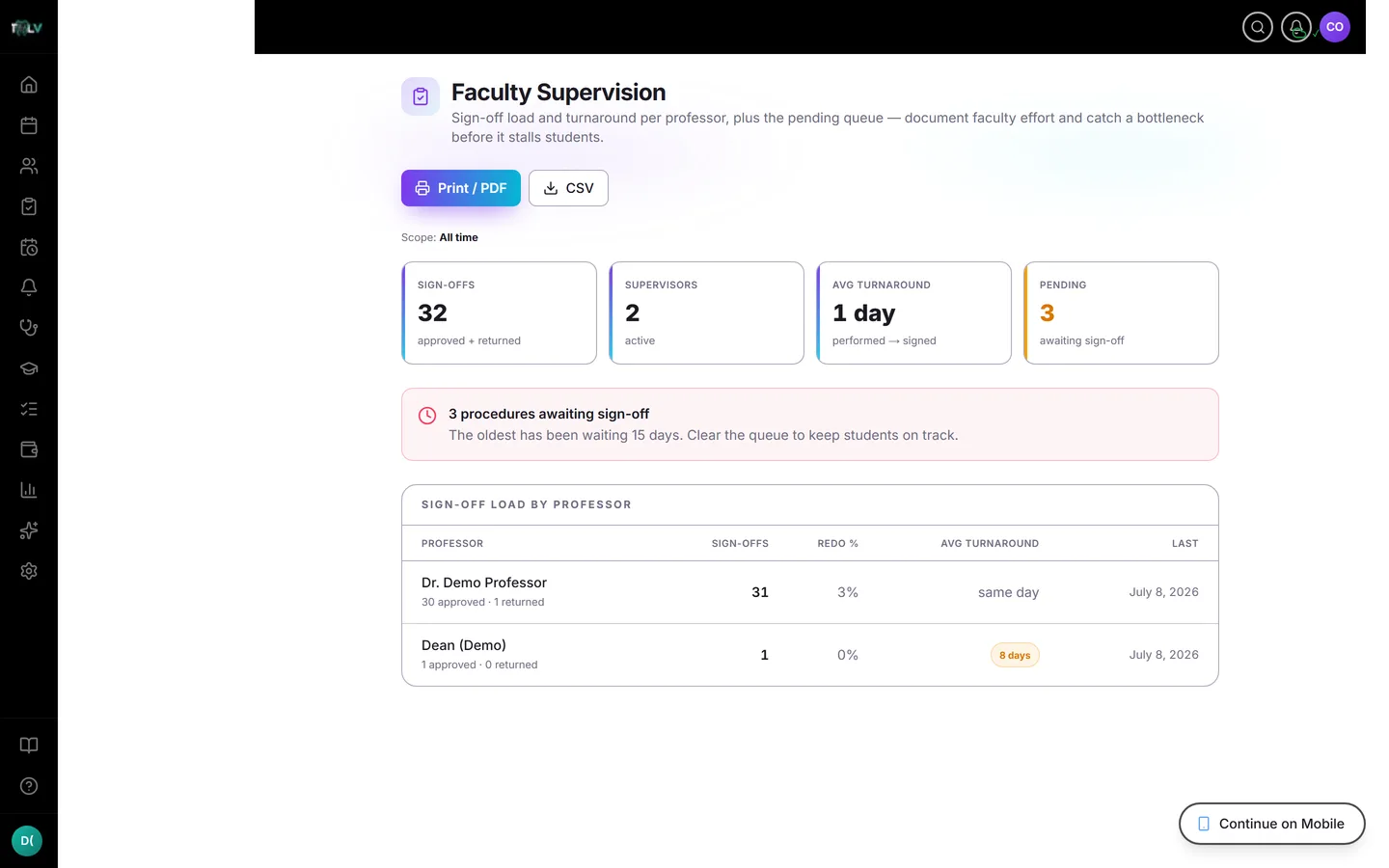
Each professor's row: total sign-offs (approved plus returned), redo rate, average turnaround (how long students wait for their verdict), and last sign-off date. Hovering shows the approved/returned split. Two flags are computed for you:
- Turnaround over 7 days — slow; students are queuing behind this desk.
- Redo rate at 25%+ — high; worth a conversation, with two honorable explanations to distinguish: a professor who grades harder than colleagues (calibration issue), or one whose assigned students genuinely need more support (teaching issue). The number starts the conversation; it doesn't finish it.
And read the flags together: a professor with 300 sign-offs and 8-day turnaround isn't slow — they're overloaded, and the fix is redistribution, not a reprimand.
The Pending Queue
The live counter shows work awaiting sign-off right now, with the oldest waiting item highlighted — amber past 7 days, urgent past 14. Deliberately always all-time, even when the table is term-scoped: waiting work never disappears behind a filter, because a stale queue distorts every other academic number in the system (progress, standing, report cards all read from approved work).
The Fairness Function
Supervision load is faculty workload data with names on it. The table documents effort for performance reviews, exposes lopsided assignment before it becomes resentment, and gives the dean the evidence to rebalance cohorts mid-term. Sharing it openly at faculty meetings tends to fix queues without anyone being asked — visible metrics are motivating that way.
Scoping and Sharing
The term selector scopes the per-professor table (default All time); the pending queue ignores it by design. Print / PDF and CSV for the faculty meeting. Weekly cadence for the dean: glance at the oldest-pending banner; if it's amber, someone's queue needs attention before the month turns it rose.
Was this article helpful?
Need more help? Contact our support team